Dry-lab Design to Wet-lab Data in 3+ Calendar Days
Trustable data at lightning speed.
Rapid progress in computational protein design, especially de novo binder design, has unleashed the interest in binders for many purposes from therapeutics, to diagnostics, to intracellular research tools. However, a huge gap exists between generating candidate sequences on the computer and obtaining functional, experimental data of the designs in the lab. State-of-the-art services take several weeks to complete this. We shrink this time to 3+ calendar days!
Five Expression Systems To Suit Your Design Purpose
Expression SystemCell-freeBinder PurificationNoneAssayBLIImmobilizedBinderBlazing Fast!


Binders are expressed in vitro from a linear DNA template. The crude reaction is diluted and the binder is loaded directly onto the biosensor, washed, and then dipped into the target solution. Loading is optimized for each binder.
Expression SystemCell-freeBinder PurificationTwinStrep+/HisAssayBLIImmobilizedTargetMonovalent Binding


Commercial targets are often supplied as Fc fusions or other bivalent constructs. With the binder on the biosensor and a bivalent target in solution, both target arms can engage at once and avidity inflates the apparent affinity. This workflow immobilizes the target and titrates the purified monomeric binder in solution, so each interaction is monovalent and the reported KD reflects intrinsic affinity. Because of the limited sensitivity of BLI, this configuration is not recommended when the target is much larger than the binder.
Expression SystemCell-freeBinder PurificationTwinStrep+AssayBLIImmobilizedBinder
Binders are expressed in a cell-free protein synthesis system and purified on their TwinStrep tag, then on their His tag. The concentration of the purified binder is measured before loading onto the probe. The target protein is in the solution.
Expression SystemCell-freePurificationVariousAssayProtein Characterization
Cell-free expression from synthesized DNA, with no cloning step and no cell culture. SDS-PAGE of the crude reaction is included in every order. Purification is optional and requires one affinity handle on each construct, either a TwinStrep tag captured on Strep-Tactin XT or a polyhistidine tag captured on Ni-NTA; on purified material it adds an apparent melting temperature by nano-DSF, SEC for monomer fraction and aggregation, and protein concentration. No target protein is used and no binding is measured, so the result characterizes the protein itself: expression, yield, thermostability and monodispersity.
Expression SystemCHO cellBinder FormatFull-length AbBinder PurificationNoneAssayBLIImmobilizedBinder


The binder is expressed as a full-length antibody in mammalian cells and used without purification: the crude supernatant is captured on the biosensor and titrated against the target in solution. Expression level does not need to be high or known in advance. This is the fastest and lowest-cost mammalian workflow. Culture scale is selected under Protocol customization.
Expression SystemCHO cellBinder FormatFull-length AbBinder PurificationProtein A/GAssayBLIImmobilizedTargetGold Standard


The binder is expressed as a full-length antibody, affinity-purified, and titrated at known concentration against a target immobilized on the biosensor. Because the antibody is bivalent, both arms can bind a densely coated surface, so the kinetics include avidity, typically as a slower apparent off-rate. Use this workflow to measure the antibody in its bivalent format; it does not report single-arm affinity. SDS-PAGE and SEC report purity and oligomeric state. Culture scale (1 mL or 30 mL) is selected under Protocol customization.
Expression SystemCHO cellBinder FormatFull-length AbBinder PurificationProtein A/GAssayBLIImmobilizedBinder
The binder is expressed as a full-length antibody and affinity-purified on a Protein A/G column. Its concentration is measured on the assay instrument, then it is captured on the probe and titrated against the target in solution. SDS-PAGE and SEC report purity and oligomeric state, and the purified antibody can be shipped to you. Culture scale is chosen under Protocol customization.
Expression SystemCHO cellBinder FormatFull-length AbPurificationVariousAssayProtein Characterization
The antibody is expressed in CHO cells at 30 mL scale as a full-length IgG and purified on Protein A/G through its own Fc. SDS-PAGE and SEC report purity and oligomeric state; thermostability and concentration measurements are optional. The antibody produced here is registered as a target protein, so a later project can raise and measure anti-idiotype binders against it.
Expression SystemCHO cellBinder FormatFabBinder PurificationNoneAssayBLIImmobilizedBinder


The binder is expressed as a Fab in mammalian cells and used without purification: the crude supernatant is captured on the biosensor and titrated against the target in solution. Expression level does not need to be high or known in advance. This is the fastest and lowest-cost mammalian workflow. Culture scale is selected under Protocol customization.
Expression SystemCHO cellBinder FormatFabBinder PurificationTwinStrep+AssayBLIImmobilizedTargetGold Standard


The binder is expressed as a Fab, affinity-purified, and titrated at known concentration against a target immobilized on the biosensor. Every binding event is therefore monovalent, and the affinity reported is intrinsic rather than avidity-inflated. SDS-PAGE and SEC report the purity and the oligomeric state of the material that was measured. Culture scale (1 mL or 30 mL) is selected under Protocol customization.
Expression SystemCHO cellBinder FormatFabBinder PurificationTwinStrep+AssayBLIImmobilizedBinder
The binder is expressed as a Fab and purified on both of the affinity handles it carries, which removes truncated chains and incompletely assembled material. Its concentration is measured on the assay instrument, then it is captured on the probe and titrated against the target in solution. SDS-PAGE and SEC report purity and oligomeric state, and the purified binder can be shipped to you. Culture scale is chosen under Protocol customization.
Expression SystemCHO cellBinder FormatFabPurificationVariousAssayProtein Characterization
The Fab is expressed in CHO cells at 30 mL scale and purified on Strep-Tactin XT through a TwinStrep tag on the Fd chain, because a Fab carries no Fc to capture. SDS-PAGE and SEC report purity and oligomeric state; thermostability and concentration measurements are optional. The Fab produced here is registered as a target protein, so a later project can raise and measure anti-idiotype binders against it.
Expression SystemCHO cellBinder FormatTag fusionPurificationNoneAssayBLIImmobilizedBinder


The binder is expressed in mammalian cells as a fusion to a human IgG1 hinge-CH2-CH3 and used straight from the crude supernatant: the Fc is caught on an anti-human Fc probe and titrated against the target in solution. The backbone supplies the Fc, so a single domain needs no tag of its own and no second chain, and the expression level does not have to be high or even known. This is the shortest way to rank a set of VHHs or scFvs by affinity. Culture scale is chosen under Protocol customization.
Expression SystemCHO cellBinder FormatTag fusionPurificationVariousAssayBLIImmobilizedTarget


The binder is expressed as a fusion to a human IgG1 hinge-CH2-CH3, purified on Protein A/G through that Fc, and used as the analyte at a known concentration against an immobilized target. An Fc fusion dimerizes through its hinge, so it carries two copies of the binding domain and can reach two immobilized target molecules at once. What this workflow reports is therefore the avidity of the dimer, not the affinity of one domain. Choose it when the bivalent format is the one you intend to use, or when the antigen will be densely presented, as it is on a cell surface. For a per-domain affinity, keep the analyte monomeric and express the domain without the Fc. SDS-PAGE and SEC report purity and oligomeric state. Culture scale is chosen under Protocol customization.
Expression SystemCHO cellBinder FormatTag fusionPurificationVariousAssayBLIImmobilizedBinder
The binder is expressed as a fusion to a human IgG1 hinge-CH2-CH3 and purified on Protein A/G through that Fc. Its concentration is measured on the assay instrument, then it is caught on an anti-human Fc probe and titrated against the target in solution. SDS-PAGE and SEC report purity and oligomeric state, and the purified protein can be shipped to you. What the kinetics mean here depends on the target: a monomeric target engages one domain at a time, so the result approaches a per-domain affinity, while a bivalent target such as an Fc fusion can bridge both domains of the dimer and the result carries avidity. Culture scale is chosen under Protocol customization.
Expression SystemCHO cellBinder FormatTag fusionPurificationVariousAssayProtein Characterization
The protein is expressed in CHO cells at 30 mL scale as a fusion to human IgG1 hinge-CH2-CH3 and purified on Protein A/G. SDS-PAGE and SEC report purity and oligomeric state; thermostability and concentration measurements are optional. Use this workflow to produce a target protein for later binding projects.
Expression SystemT cellBinder FormatCARAssayT Cell ActivationBlazing Fast!


The binder is expressed as a CAR on the surface of T cells. T cell activation against target cells is measured by ELISA or ELISPOT.
Expression SystemPre-madeBinder PurificationNoneAssaySPRImmobilizedTargetBring your own binder
For binders you already have: a peptide you had synthesised, a protein you bought, or material you ship us. Nothing is encoded, synthesised or expressed, so you pay for the measurement and not for making the molecule. The target is immobilized on the sensor and your binder is titrated over it.
Access and Organize Your Data In User-friendly and AI-accessible Portal
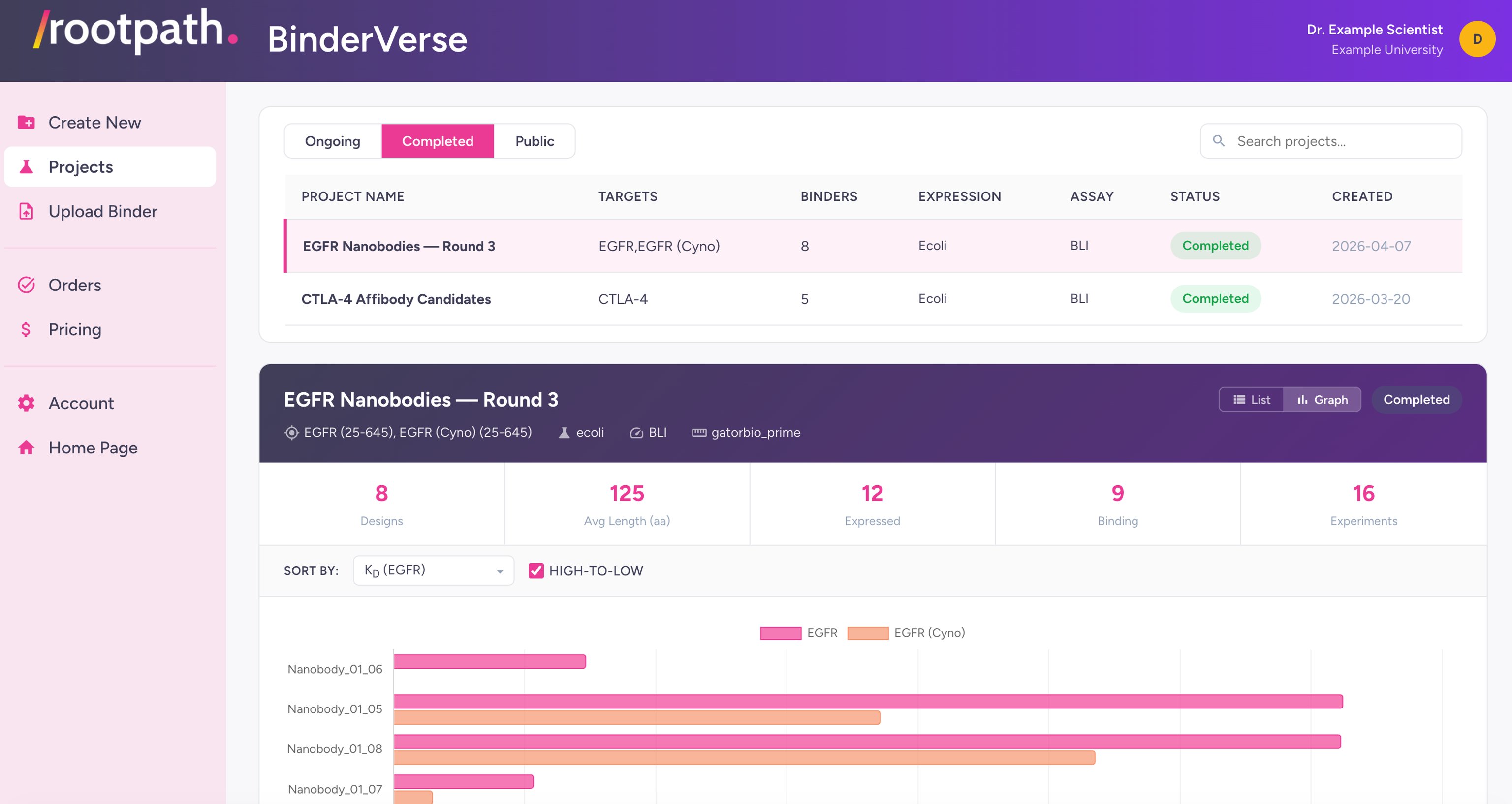
You can batch upload the binder sequences, choose target and experimental parameters (e.g., expression system, number of replicates), and we will take care of the rest. Once your data is ready, you can access your data in our user-friendly portal. To further remove barrier, we open API end points to create projects and view data.
Cost Estimate
Choose your testing format, scale, and assay details. The price, plate layout, and turnaround update live. Numbers are estimates. Final quote will be issued to you after project submission.